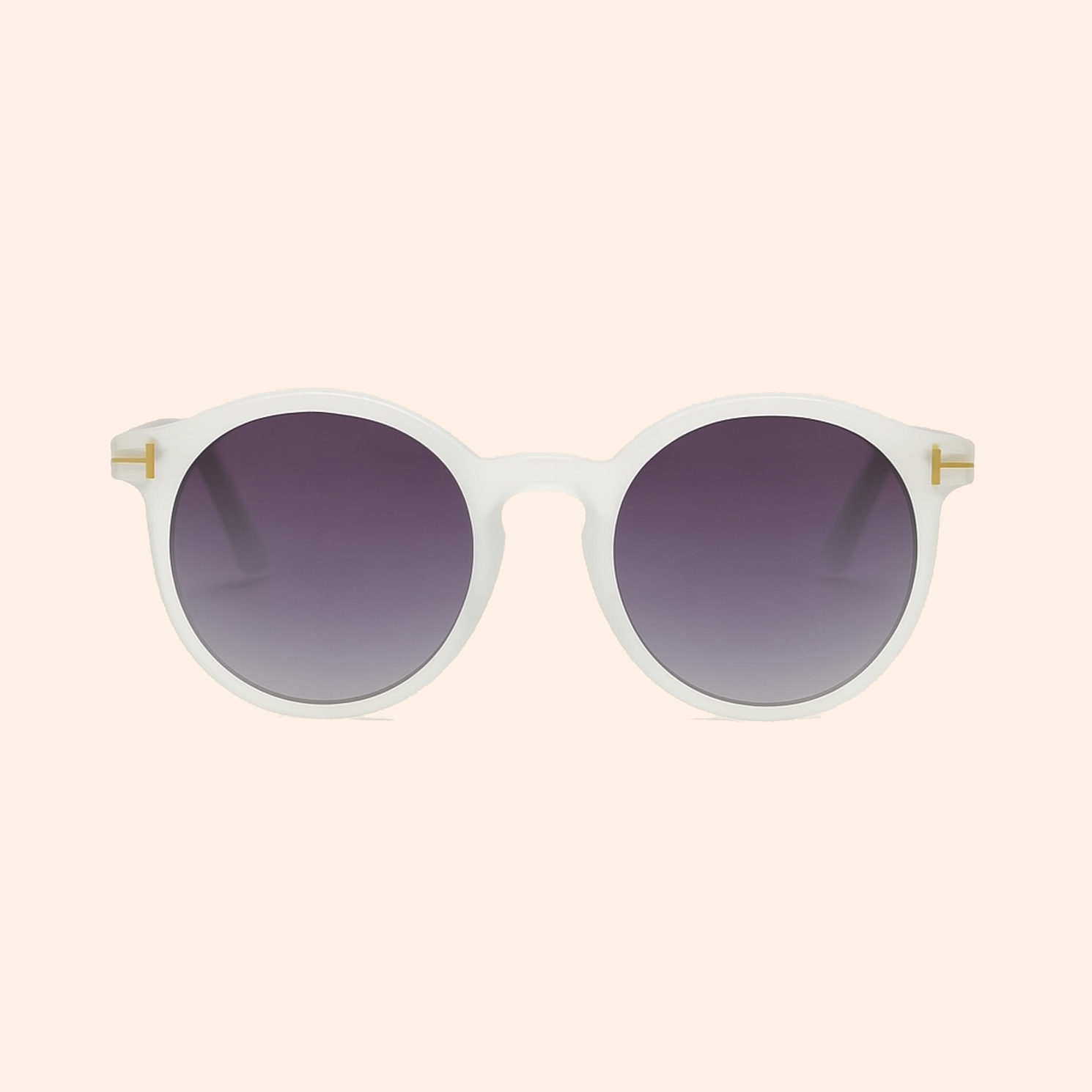
Round Sunglasses for WomenRound Sunglasses for Women
Shop by Shape

Round Sunglasses for Women

Circle frames — the oldest shape in eyewear, and the one that flatters almost every face except the one it is named after.

The most misunderstood shape in eyewear

Round sunglasses get told to stay away more than any other shape, and the advice is usually aimed at the wrong person. Circle frames are the single best choice for a square or rectangle face, they soften a strong jaw better than anything else, and they are one of the few shapes a heart or diamond face can wear without thinking about it.

The one face they genuinely fight is a round one — which is where almost all the confusion comes from. Below: metal and acetate circles, small retro discs through to oversized, all UV400, from Rs. 1,199.

  • 100% UV400 protection
  • Free shipping over Rs. 999
  • 7-day easy returns
  • Cash on delivery
9 items
Auric - Round
Auric - Round
Rs. 3,399.00
Orbiton black round sunglasses for women — Rangrays
Orbiton - Round
Rs. 1,199.00
Soleil - Round
Soleil - Round
Rs. 2,799.00
Sphere black round sunglasses for women — Rangrays
Sphere - Round
Rs. 1,199.00
Luna Haze - Round
Luna Haze - Round
Rs. 1,899.00
Tortoise Moon - Round
Rs. 2,499.00
Solara - Round
Solara - Round
Rs. 1,199.00
Ivory - Round
Ivory - Round
Rs. 1,499.00
Crimson Orbit - Round
★★★★★(1)
Rs. 2,799.00

Not quite it? Try another shape

Frame Finder

Are circle frames right for you?

Round frames suit more faces than their reputation suggests — and one face shape they genuinely don't. Six quick questions and the Frame Finder tells you yours, then sends you to the frames built for it.

Find my shape

The guide

How to choose round and circle sunglasses

Round frames are the shape people are most often told to avoid — and the advice is usually meant for someone else. Here is who they actually suit, how much diameter you want, and the difference between a round frame and a true circle.

Round or circle? A real distinction

The two words get used interchangeably, but they describe different frames:

  • Circle sunglasses are a true circle — as tall as they are wide. The purest form of the shape, and the strongest statement.
  • Round sunglasses is the broader term: any curved lens with no corners, including the slightly wider-than-tall shapes that most people actually find easiest to wear.

If you have tried circle frames and found them too much, you probably tried a true circle. A round frame that is a few millimetres wider than it is tall reads far more wearable while keeping everything that makes the shape work. Both are in this edit.

Round frames are not for round faces

If you arrived here looking for frames to suit a round face, the round face edit is the page you want — it is built from cat-eye, square and hexagon shapes that add the definition a round face is missing.

Which face shapes suit round sunglasses

  • Square — the strongest match. A circle has no line in common with a square jaw, so the contrast softens it without any effort from you.
  • Rectangle and oblong — adds curve and width to a face with near-parallel sides.
  • Heart — the full lower curve fills out the space either side of a narrow chin.
  • Diamond — rounds off high cheekbones and fills out a narrow forehead.
  • Oval — nothing needs correcting, and this is a shape most face shapes cannot wear. Take advantage.

Size is the whole decision

More than any other shape, a round frame changes character entirely with diameter. The same outline at 44 mm and at 54 mm are two different products — one is a costume decision, the other is an everyday pair.

What to check Look for Why it matters
Lens diameter 48–54 mm for everyday Under 46 mm is a deliberate retro statement; over 54 mm reads oversized and fashion
Width vs height Slightly wider than tall A true circle is the boldest version — a fraction wider is far easier to wear
Lower edge Clearing your cheek when you smile Round frames are the most likely shape to rest on the cheeks and ride up
Rim material Thin metal or thick acetate Metal reads intellectual and retro; acetate reads fashion and modern
Bridge Keyhole or adjustable pads Round frames sit high — the bridge is what keeps them there

Metal or acetate

The same circle in two materials produces two completely different frames. A thin metal round is the classic — wire-rimmed, quiet, slightly bookish, and the version that has been in continuous production for a century. A thick acetate round is the modern take: bolder, more graphic, more obviously a fashion choice. Neither is more correct; they suit different wardrobes.

Colour and tint

Round frames are where tinted lenses look most at home — the shape has a retro association that carries colour comfortably, which is why rose, amber and smoke tints appear on circles more than on any other outline. Gradient lenses work particularly well because the fade follows the curve rather than cutting across it. For an everyday pair, black or tortoiseshell keeps it grounded.

How to style women's round shades

Round frames are the most relaxed shape in eyewear — they soften a look rather than sharpening it, which makes them the natural pair for linen, denim, festival dressing and anything with movement in it. They also sit beautifully with a saree, where the curve echoes the drape instead of fighting it.

One styling note: round frames and round hoop earrings repeat the same shape at the same height. Either commit to it fully as a look, or switch to a drop or stud.


The oldest shape there is

Every early pair of spectacles was round, and not for style reasons — lenses were ground on a rotating wheel, so a circle was simply what the process produced. For centuries there was no other option. Every shape that followed, from the oval to the wayfarer, exists because manufacturing eventually caught up with design. Which makes the circle the only frame shape that was never a trend: it was the default, and it stayed.

Round Sunglasses — FAQs

Square, rectangle, heart and diamond faces all suit them, and square faces suit them best — a circle shares no line with a square jaw, so the contrast softens it. The one exception is a round face, where circle frames echo curves the face already has.

Not usually. Frames are named for their own outline, not the face they suit. A round frame on a round face doubles the curves rather than balancing them — cat-eye, square and hexagon shapes add the definition a round face is missing instead.

A circle frame is a true circle — as tall as it is wide, and the boldest version of the shape. Round is the broader term for any curved, cornerless lens, including the slightly wider-than-tall frames most people find easiest to wear.

A lens diameter of 48–54 mm suits most people for everyday wear. Under 46 mm is a deliberate retro statement; over 54 mm reads oversized. Check the lower edge clears your cheek when you smile — round frames are the most likely shape to rest on the cheeks and ride up.

Thin metal reads classic, quiet and slightly retro — it's the version that has been in continuous production for a century. Thick acetate reads modern, graphic and more obviously fashion. Same outline, two very different frames.

Round is the only frame shape that was never a trend. Early spectacles were round because lenses were ground on a rotating wheel and a circle was what the process produced. Every other shape exists because manufacturing later caught up with design.

Round frames carry tints better than any other shape — the retro association makes rose, amber and smoke look natural rather than costume. Gradient lenses suit them especially well, because the fade follows the curve rather than cutting across it.

Yes. Every pair in this collection is UV400 — blocking 100% of UVA and UVB rays — and ships with a hard case and cleaning cloth, with a 7-day return window.